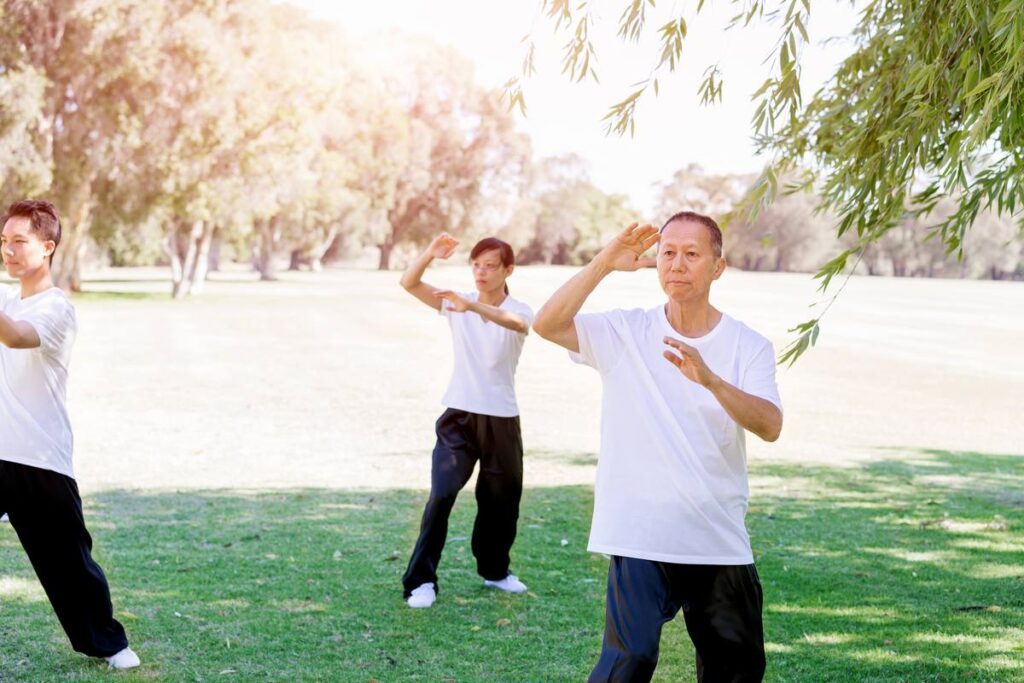
It’s one of the first questions nearly every beginner asks: How long until I actually know Tai Chi? It’s a fair question, and the honest answer is delightfully layered. You can feel real benefits after a single session, learn a short sequence in a few weeks, and memorize an entire form within a few months. And yet, in another sense, you never stop learning Tai Chi at all. Let’s unpack what that really means, with a realistic timeline you can plan around.
First, What Does It Mean to “Learn” Tai Chi?
There’s an important distinction hiding inside this question, and understanding it removes a lot of frustration.
Learning Tai Chi happens on two levels. The first is learning the movements, the outer choreography of a form, the sequence of steps and gestures. This part is very learnable and has a clear finish line. The second is developing skill: the relaxation, alignment, balance, breath, and internal awareness that give the movements their depth and power. This second part deepens for as long as you practice.
So when we talk about timelines below, we’re mostly talking about learning the movements. The skill is the lifelong reward that keeps the practice endlessly interesting.
A Realistic Timeline for Learning Tai Chi
Everyone progresses differently, but here’s a typical arc for someone practicing regularly, using the beginner-friendly Yang-style 24-form as a reference point.
Your first session: You won’t “know” a form yet, but many people feel calmer, looser, and more relaxed right away after their first class. That immediate sense of ease is often what hooks people.
The first few weeks: You’ll learn the fundamentals, how to stand, root, and breathe, and pick up your first handful of movements. Things will feel awkward, and that’s completely normal. This is the foundation phase, and it matters enormously.
One to three months: With consistent practice, you’ll string together a short sequence and start to feel the movements become less clumsy. You’re building “body memory,” and the practice starts to feel like yours.
Three to six months: Practicing a few times a week, most people can work through the full 24-form from memory, even if it’s not yet smooth. Reaching this milestone is genuinely satisfying, you can now “do” the form.
Six to twelve months: The choreography fades into the background and the qualities begin to emerge: smoother transitions, better balance, more relaxed power, and breath that flows with the movement. This is where Tai Chi starts to feel less like remembering and more like moving.
Years and beyond: Here’s the beautiful part. Long after you’ve memorized the form, you keep refining it, discovering deeper relaxation, subtler alignment, and the internal aspects that masters spend a lifetime exploring. In Tai Chi, there’s always another layer.
What Affects How Quickly You Learn
Your personal pace depends on several factors.
How often you practice. Frequency beats everything. Short, regular sessions build skill far faster than occasional long ones. The quality of your guidance. A good instructor or structured program helps you learn correctly the first time, so you’re not slowed down by common beginner mistakes. The complexity of the form. Simplified forms like the 24-form are designed to be learned relatively quickly; longer traditional forms take more time. Your movement background. Prior experience with dance, martial arts, yoga, or similar practices can shorten the learning curve, but it’s never a requirement.
Why “Never Finished” Is Good News
If you were hoping to hear “six weeks and you’re done,” the idea of a lifelong practice might sound daunting at first. But flip it around: Tai Chi is one of the very few activities you can genuinely keep improving at for the rest of your life, at any age. There’s no ceiling, no point where it gets boring, and no age at which you’re “too late.” Every practice offers something new to discover. That’s not a burden, it’s the gift.
How to Learn Tai Chi Faster
If you’d like to progress as efficiently as possible: practice a little every day rather than a lot once in a while; slow your movements down so your body can absorb them; focus on doing one movement well before adding the next; and get quality instruction early so you build clean habits from the start. Patience, oddly enough, is the fastest route, trying to rush almost always slows you down.
Common Questions About Learning Tai Chi
Is Tai Chi hard to learn? The individual movements are slow and simple, which makes Tai Chi very approachable for beginners. The lifelong challenge, and joy, is refining the quality of those movements over time.
How long does it take to learn the 24-form? With regular practice a few times a week, many people can work through the full Yang-style 24-form from memory within three to six months, then spend much longer refining it.
Can I learn Tai Chi quickly? You can learn the basics and a short sequence within a few weeks. “Quick” mastery isn’t really the goal in Tai Chi, but steady, consistent practice produces noticeable progress surprisingly fast.
How often should I practice to learn faster? Short daily sessions are ideal. Consistency matters far more than the length of any single practice.
Do I need a teacher to learn Tai Chi? Not strictly, many people begin at home with structured lessons. For a full breakdown, see our guide: Can You Learn Tai Chi at Home Without a Teacher?
Shorten Your Learning Curve with Tai Chi Mastery
The single biggest factor in how quickly you learn is how well you’re guided from the start. Tai Chi Mastery is SOHMA’s online membership that walks you step by step from your very first movement through the complete Yang-style form, under the instruction of Chief Instructor Dr. Daniel Hoover.
Because the lessons are structured, sequential, and yours to replay anytime, you build clean habits and steady momentum, exactly what turns “someday” into real, measurable progress.
Explore the Tai Chi Mastery membership and start your timeline today.
About Dr. Daniel Hoover
Dr. Daniel Hoover, DC, LAc, MH, CCSP®, integrates a rare fusion of clinical expertise and martial mastery to elevate the health of his patients and students. As a Doctor of Chiropractic, Licensed Acupuncturist, and 5th degree black belt in Shaolin Kempo, Dr. Hoover serves as the Chief Tai Chi Chuan instructor at the School of Healing Martial Arts™. His journey as an Ironman and Master Herbalist informs his unique understanding of how the body thrives under disciplined practice. To expand his impact beyond the local clinic, Dr. Hoover developed online Tai Chi courses, making these traditional healing arts accessible for any wellness journey. If you are ready to begin, we invite you to explore Tai Chi Mastery under the expert guidance of Dr. Daniel Hoover.