How the Art Evolves With You, From Movement to Skill, From Effort to Awareness
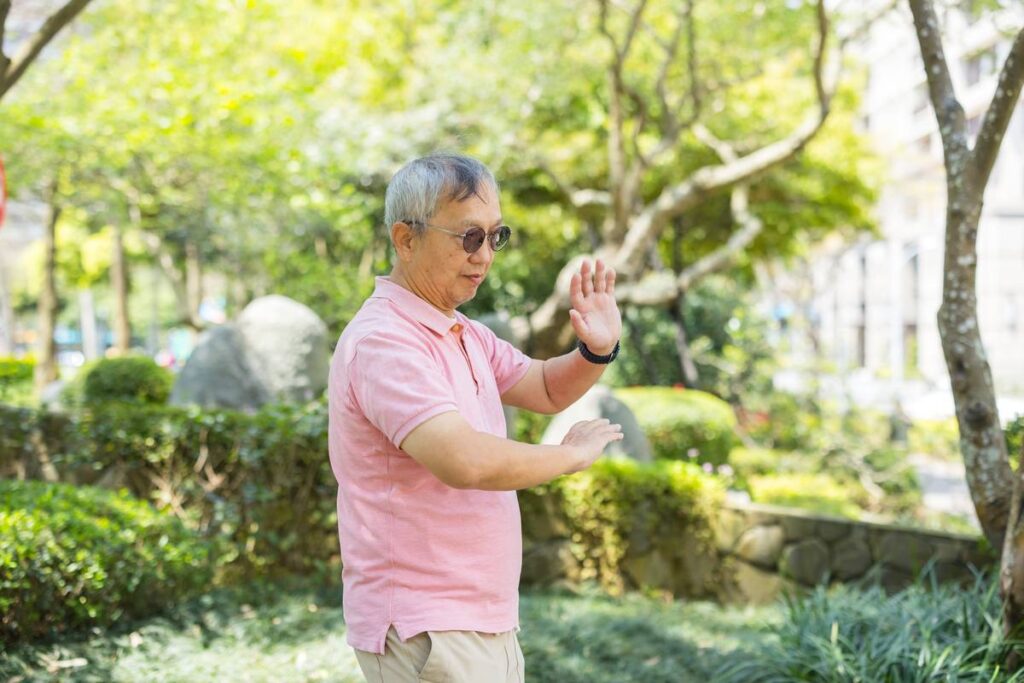
Most physical practices are designed around a peak. They reward youth, strength, speed, or endurance, and quietly become less accessible as the body changes. Tai Chi follows a different logic entirely, rather than peaking and declining, Tai Chi unfolds. As practitioners age, Tai Chi does not ask them to maintain the same physical capacities. It asks them to refine coordination, awareness, and presence. This is why Tai Chi has endured for centuries as a lifelong discipline, and why its most respected practitioners are often those with decades of experience.
This pillar article explores Tai Chi as a long-term developmental path, weaving together four essential perspectives: aging and adaptability, stages of progression, the difference between movement and skill, and the emergence of Tai Chi as a moving meditation.
A Practice That Improves Rather Than Expires
One of Tai Chi’s most distinctive qualities is its compatibility with the aging process. Unlike practices that depend on maximal output, Tai Chi trains qualities that mature over time. In “Why Tai Chi Is One of the Few Practices You Can Improve at Any Age,” we explore how Tai Chi is fundamentally a neurological practice. It refines everything from balance and coordination to timing, and emotional regulation. Because neural plasticity persists across the lifespan, Tai Chi remains fertile ground for improvement well into your later years. Equally important is Tai Chi’s joint-friendly approach. Movement is smooth, and supported by alignment instead of straining your muscles. This allows practitioners to continue refining skill without accumulating wear and tear. Tai Chi incorporates physical change, replacing force with efficiency, and effort with clarity.
Across generations, lifelong practitioners demonstrate this truth. Their movements may appear simpler, but their balance, calm, and precision reveal a depth that only time can produce.
How Tai Chi Evolves as You Do
Tai Chi does not remain the same practice over time, even though the form itself may not change. What evolves is what the practitioner is training. As outlined in “How Tai Chi Evolves as You Progress from Beginner to Master,” early practice is necessarily external. Beginners need to focus on learning the sequence, and coordinating limbs in order to build consistency. Meanwhile, attention is occupied with remembering what comes next.
As familiarity grows, training priorities shift. The form becomes a container for refinement rather than memorization. Practitioners begin to notice their body’s balance, alignment, breath, and tension patterns. Their movements grow quieter, and effort gives way to subtlety.
At advanced stages, Tai Chi emphasizes internal refinement. Progress becomes less visible yet more profound. Timing, and responsiveness take precedence over size or speed. At this stage, teaching often emerges naturally, not necessarily as an endpoint, instead as part of the mastery itself. Explaining and transmitting the art deepens the embodiment of Tai Chi.
Through every stage, one quality remains constant: a lifelong learning mindset. Tai Chi masters are not defined by arrival, but by continued refinement.
Movement Is Not the Same as Skill
One of the most common reasons practitioners plateau is a misunderstanding of what Tai Chi skill actually is. Learning the movements grants access to the art, however, it does not guarantee depth.
In “The Difference Between Learning Tai Chi Movements and Learning Tai Chi Skill,” we discussed memorization as only a starting point. Movements can be repeated accurately for years without developing internal mechanics. Skill develops when attention shifts from appearance to function. For example, how weight transfers, how structure supports movement, and how the body coordinates as a whole, cannot be learned through repetition alone. They require feedback, and awareness-based training.
Many practitioners get stuck precisely here. When the form feels familiar, improvements become unclear and difficult to see. Without changing how one practices, repetition can reinforce poor habits rather than refining skill.
From Practice to Presence: Tai Chi as Moving Meditation
Over time, something else begins to change. As movement becomes more stable, effort decreases, and attention no longer fragments. This awareness settles into the body and stays there, even while moving.
As described in “How Tai Chi Becomes a Moving Meditation Over Time,” this meditative quality does not appear at the beginning. Instead it emerges gradually as your breathing synchronizes naturally with movement and continuous awareness replaces conscious control. While some practitioners may find it difficult, letting go of performance is essential here. When movement is no longer evaluated externally, internal sensation guides practice. The nervous system learns to remain calm during motion, not just in stillness. Tai Chi becomes a training ground for regulated movement under changing conditions.
Eventually, this awareness extends beyond practice. Posture, breath, and responsiveness carry into daily life.
Why Tai Chi Endures as a Lifelong Path
Taken together, these perspectives reveal why Tai Chi has endured across centuries and cultures. It does not rely on peak performance. It evolves with the practitioner. It distinguishes between surface learning and real skill. And it integrates awareness into motion and life itself.
Tai Chi offers improvements at any age, it develops skill and strength without excessive joint strain. It provides lifelong depth without requiring constant novelty, while cultivating calm while remaining fully engaged with daily life. This is not accidental, as Tai Chi was designed as a system of refinement, not exhaustion.
Choosing the Long View
To walk Tai Chi as a lifelong path is to accept that progress will change form. Early gains are visible. Later gains are subtle. Eventually, refinement becomes internal, relational, and integrated into daily living.
Those who stay discover that Tai Chi never runs out of depth, because the practitioner never stops changing. The movements remain, the awareness deepens, the path continues.
That is the promise of Tai Chi, not as a technique, but as a way of evolving with time rather than resisting it.
Dr. Daniel Hoover, DC, LAc, MH, CCSP®, integrates a rare fusion of clinical expertise and martial mastery to elevate the health of his patients and students. As a Doctor of Chiropractic, Licensed Acupuncturist, and 5th degree black belt in Shaolin Kempo, Dr. Hoover serves as the Chief Tai Chi Chuan instructor at the School of Healing Martial Arts™. His journey as an Ironman and Master Herbalist informs his unique understanding of how the body thrives under disciplined practice. To expand his impact beyond the local clinic, Dr. Hoover developed online Tai Chi courses, making these traditional healing arts accessible for any wellness journey. If you are ready to begin, we invite you to explore Tai Chi Mastery under the expert guidance of Dr. Daniel Hoover.