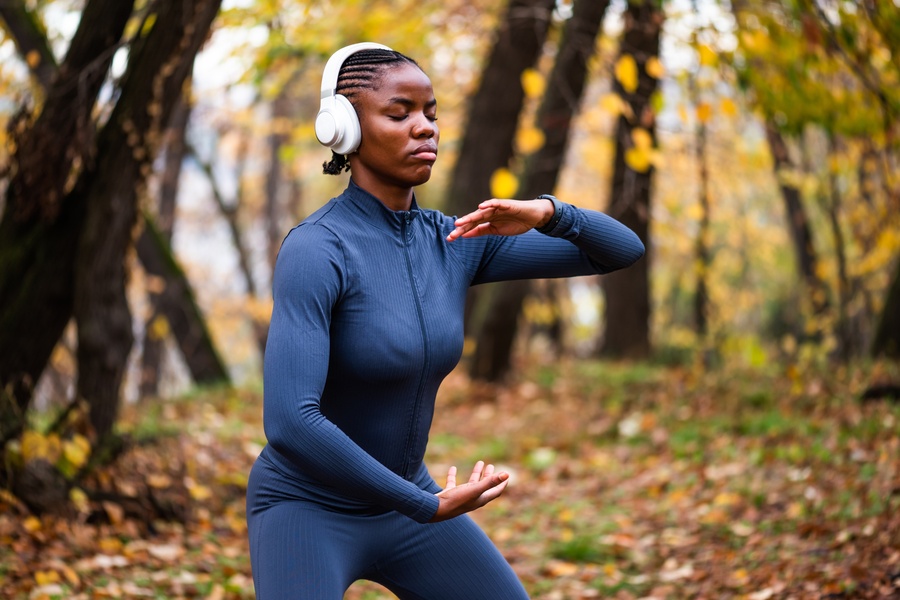
Stress is not just a mental experience, it is a physiological state driven by your nervous system. Tai Chi’s greatest strength lies in how directly it trains that system to shift out of chronic stress and into regulation. Rather than “relaxing” by distraction, Tai Chi teaches the body how to physically exit stress responses.
Understanding Stress as a Nervous System Pattern
Most modern stress is driven by prolonged activation of the sympathetic nervous system, which governs fight, flight, or freeze responses. When this system remains active for extended periods, it can lead to elevated cortisol levels and shallow breathing. It may also contribute to persistent muscle tension, increased pain, and heightened mental reactivity. Over time, this state can disrupt sleep quality and impair digestion.
Tai Chi works not by suppressing stress, but by gradually retraining the nervous system’s default state. Through slow movement and controlled breathing, it encourages a shift toward parasympathetic activity. This shift supports relaxation and recovery without force. Consistent practice helps restore balance between activation and rest.
Parasympathetic Activation Through Slow Movement
One of Tai Chi’s most researched benefits is its ability to activate the parasympathetic nervous system, often called the rest and digest response. It does this by slowing movement below stress thresholds and eliminating sudden acceleration or impact. Continuous and rhythmic motion is maintained while coordinating movement with breathing. This combination signals safety to the nervous system and allows stress responses to downshift naturally. Over time, the body begins to favor recovery states rather than prolonged activation.
This supports overall regulation and long-term resilience.
Breath Regulation Without Force
Unlike breathing techniques that require conscious control, Tai Chi uses movement-led breath regulation. As practice deepens:
- Breathing becomes slower and more diaphragmatic
- Breath synchronizes organically with motion
- Breath depth increases without effort
This is critical, because forced breathing can actually increase anxiety. Tai Chi allows the breath to regulate because the body feels safe.
Mindful Movement as Sensory Re-education
Tai Chi retrains awareness at the sensory level. Instead of focusing on thoughts, practitioners learn to track:
- Weight shifts through the feet
- Subtle changes in balance
- Muscle tone and release
- Continuous spatial awareness
This sensory focus interrupts rumination and worry loops, giving the mind something tangible to anchor to, without dissociation.
Cortisol Reduction Through Consistency
Regular Tai Chi practice has been shown to reduce baseline cortisol levels over time. This matters because cortisol affects:
- Blood sugar regulation
- Fat storage
- Immune function
- Sleep quality
Rather than providing temporary relief, Tai Chi lowers stress at the hormonal level through repetition and consistency.
Emotional Resilience, Not Emotional Suppression
Tai Chi does not numb emotions but builds emotional resilience by training the body to remain regulated as sensations arise. Over time, practitioners often experience faster recovery from emotional stress and reduced reactivity to triggers. They may also develop greater emotional clarity and a higher tolerance for uncertainty. This process supports more stable and adaptive responses.
This nervous-system-first approach makes Tai Chi foundational not only for stress relief, but also for anxiety management and sleep improvement, topics explored further in this cluster.
Dr. Daniel Hoover, DC, LAc, MH, CCSP®, integrates a rare fusion of clinical expertise and martial mastery to elevate the health of his patients and students. As a Doctor of Chiropractic, Licensed Acupuncturist, and 5th degree black belt in Shaolin Kempo, Dr. Hoover serves as the Chief Tai Chi Chuan instructor at the School of Healing Martial Arts™. His journey as an Ironman and Master Herbalist informs his unique understanding of how the body thrives under disciplined practice. To expand his impact beyond the local clinic, Dr. Hoover developed online Tai Chi courses, making these traditional healing arts accessible for any wellness journey. If you are ready to begin, we invite you to explore Tai Chi Mastery under the expert guidance of Dr. Daniel Hoover.