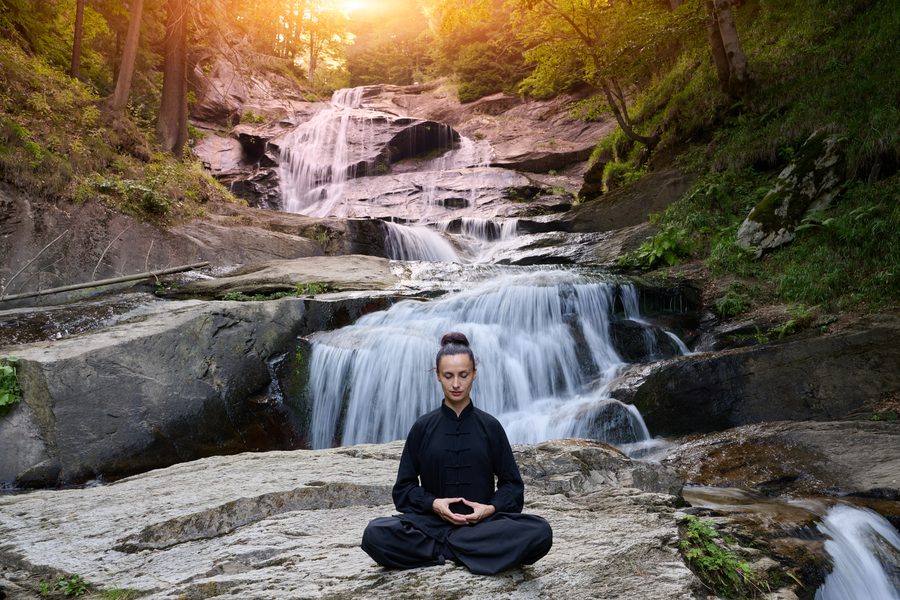
It sounds like a contradiction: slow down to get better faster. But anyone who has spent serious time with Tai Chi eventually discovers this is true. Moving slowly isn’t just a stylistic choice, it’s one of the most effective tools for advancing your Tai Chi practice.
Slowness Reveals What Speed Hides
When you move quickly through a form, the body relies on momentum and habit. Small imbalances get glossed over. Tension you’ve been carrying for years stays invisible. The sequence happens, but a lot of important information never surfaces.
Slow everything down, and suddenly that information appears. You notice the moment your weight becomes uncertain during a shift. You feel exactly where you’re gripping or holding. You find the transition you’ve been rushing through without realizing it. All of that is material to work with, the kind of material that drives real skill development in Tai Chi.
Slowing Down Trains the Nervous System
Tai Chi isn’t just a physical practice, it’s a nervous system practice. And the nervous system learns best when it has time to process what’s happening.
Moving slowly gives the brain and body time to reorganize coordination, sharpen proprioception, and integrate new patterns properly. The result, over time, is movement that feels smoother and more reliable, not because you’ve gotten stronger, but because the system running the movement has gotten smarter.
Precision Develops Through Slowness
Advanced Tai Chi has a certain exactness to it. Timing, sequencing, weight placement, they all start to feel precise rather than approximate. That precision doesn’t happen at full speed first. It develops slowly, and then carries over.
Practitioners who spend real time working slowly tend to retain that quality when speed increases. This is a recurring theme in any honest conversation about how real Tai Chi skill is developed beyond the form.
Slowness Encourages Relaxation Without Collapse
One of the harder problems in Tai Chi is unnecessary tension. Most people carry more of it than they realize, and it’s hard to feel at normal speeds.
Slow practice creates the conditions where tension becomes obvious and where it’s actually possible to release it. The key is that slowing down doesn’t mean going limp, structure still matters. Slowness helps you find the balance between genuine relaxation and organized support. This balance is a hallmark of advancing your practice in Tai Chi.
Mental Focus Deepens When Movement Slows
Fast practice tends to be goal-oriented: get through the form, hit the positions, move on. Slow practice shifts the whole frame. The destination matters less. What’s happening right now matters more.
That shift cultivates something genuinely valuable: sustained present-moment attention combined with physical engagement. It’s what gives Tai Chi its meditative quality, not just moving through a sequence, but actually being there for it.
Overcoming Resistance to Slowing Down
A lot of practitioners resist this. Slowing down feels uncomfortable. It exposes things you’d rather not see. That discomfort is precisely the point, it’s telling you where the work is.
The shift in attitude that helps most is treating the discomfort as information rather than a problem. What’s being revealed is something that was always there. Now you can actually do something about it. That reframing is part of what “going beyond the form” really means, as explored in depth in this guide on advancing your Tai Chi practice.
Integrating Slowness Into Practice
You don’t need to redo your entire practice from scratch. Pick specific sections, particularly transitions, which is usually where the most information hides. Practice them at reduced speed with real attention. Even brief periods of this, done consistently, produce meaningful results.
The paradox holds: in Tai Chi, doing less, more slowly, more carefully, gets you further than doing more. That quiet truth is at the center of real skill development beyond the form.
We invite you to take your Tai Chi to the next level through our membership program. Whether you want to eventually become a certified Tai Chi instructor or you just want to ensure you are in the best shape of your life using Tai Chi, our membership and community will help you with educational videos and a path to your best health. You can get started with our Tai Chi Community for free to see what the community is talking about.