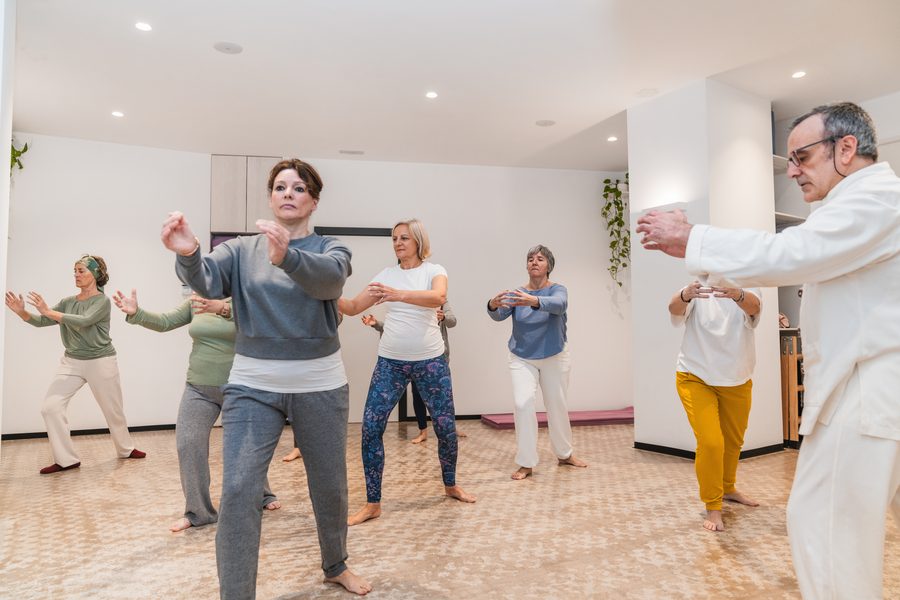
Most beginners focus on what their Tai Chi looks like, where the hands go, what the stance is supposed to be, whether the sequence is right. That’s totally reasonable at first. But at some point, the question shifts from “does this look correct?” to “does this feel right?”
That shift is where internal alignment comes in, and it’s one of the central themes in advancing your Tai Chi practice beyond the form. It sounds almost mystical until someone helps you feel it. Then it’s obvious.
What Internal Alignment Really Means
Internal alignment isn’t about posture in the conventional sense. It’s about how your body organizes itself from the inside, how joints relate to each other, how weight travels through the structure, whether there’s continuity from your feet up through your spine and out through your arms.
Two people can do the same movement and have completely different internal experiences. One feels effortful and unstable. The other feels almost automatic. The difference is usually alignment, a key element of how real Tai Chi skill is developed.
Alignment as the Foundation of Balance
Balance in Tai Chi isn’t about muscular strength, it’s about structure. When your skeleton is organized well, the body can hold itself up with surprisingly little effort. Balance stops being something you maintain and starts being something you simply have.
When alignment is off, even slightly, muscles start compensating. That’s where tension creeps in. Over time it leads to fatigue, inconsistency, and that frustrating feeling that you can never quite settle into a stance.
How Internal Alignment Enables Relaxation
Here’s a paradox a lot of practitioners discover: you can’t truly relax without structure. Without alignment, relaxation just becomes collapse.
When the skeleton is organized well, the muscles can actually let go, because they don’t need to work as hard to keep you upright. This is one reason why advancing your Tai Chi practice always comes back to structural refinement. Practitioners who’ve nailed this describe Tai Chi suddenly feeling much lighter and more spacious.
Power Without Effort
For anyone interested in Tai Chi’s martial dimensions, internal alignment is where whole-body power comes from. It’s what allows a relatively small movement to carry real force, not from isolated muscles, but from a coordinated structure.
Even if you’re practicing purely for health, this matters. Efficient movement is kinder to your joints and less draining overall. Practitioners with good alignment tend to practice longer with less fatigue, which means they’re building something sustainable. That efficiency is central to real skill development in Tai Chi.
Alignment and Injury Prevention
Bad alignment is one of the most common sources of discomfort in Tai Chi, and in daily life. Knees tracking poorly, the spine under unnecessary strain, upper and lower body disconnected. These patterns often develop slowly and feel normal until they cause a problem.
Refining internal alignment teaches you to recognize these patterns and gently correct them. That awareness tends to carry over into how you sit, walk, and carry things. The practice extends beyond the practice.
Where to Start
You can’t really work on internal alignment by thinking your way into it. It takes slowing down and paying attention, to how weight settles into the floor, how the pelvis supports the spine, how the head balances without effort.
An experienced instructor can save you a lot of time here. Internal misalignments are notoriously hard to feel on your own. For broader context on why this work matters so much, see how real skill is developed beyond the form.
Why Alignment Changes Everything
When internal alignment comes together, Tai Chi stops feeling like a series of disconnected movements and starts feeling like a coherent, unified thing. Balance becomes reliable. Effort goes down. Effectiveness goes up.
It’s one of the clearest signs that a practice is maturing, and it’s available to anyone willing to pay attention.
We invite you to take your Tai Chi to the next level through our membership program. Whether you want to eventually become a certified Tai Chi instructor or you just want to ensure you are in the best shape of your life using Tai Chi, our membership and community will help you with educational videos and a path to your best health. You can get started with our Tai Chi Community for free to see what the community is talking about.