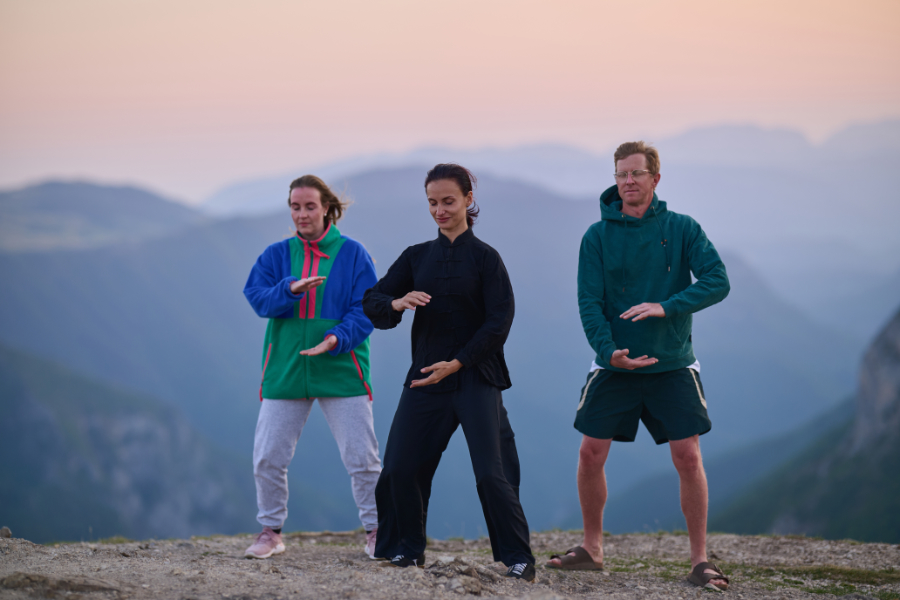
Paradox of Effortlessness
Advanced Tai Chi often looks easier than beginner practice, this is because movements tend to become slower, smoother and visibly look less strenuous. You notice practitioners shake less and show fewer signs of making an effort. To the average observer or newcomer to Tai Chi, it may appear as though they are doing less. However, the internal demand of practice actually increases significantly. What changes isn’t the level of work being done, it’s actually the type of work being performed. As beginners, students rely on muscular tension for stability, as such effort is more visible. Although as skills develop the unnecessary tension is reduced, the body then appears calm though that calmness requires more refined coordination and control.
Increased Sensitivity and Precision
At the advanced levels of Tai Chi, precision becomes the focus of practice. Minor shifts in weight, subtle alignment changes, and a continuous balance adjustment requires a practitioner to be more aware of their body. Unlike beginners who make large corrections when learning new forms, advanced practitioners make micro adjustments that can seem invisible to those with less experience. This increased sensitivity to their movements demands higher concentration. The practitioner must feel how their feet connect to the ground, as well as how the spines over the hips and how the arms are able to move without disrupting balance. Small errors can become more noticeable because the margin for inefficiency narrows as you progress. Muscle strength and force is no longer produced through obvious muscular exertion, rather it is redirected through structure and timing.
Advanced Practitioners Fatigue Mentally, Not Physically
Although Tai Chi is rarely exhausting for practitioners of any level, advanced Tai Chi can be tiring in non-conventional ways. While your heart rate may remain steady, and your breathing may stay controlled, practitioners have reported mental fatigue after sustained practice. This generally occurs because attention must remain consistent throughout the practice. Balance, breathing, posture, timing and intent must all align simultaneously. While beginners can lean on the tension from their muscles for support, once that support is removed practitioners must maintain awareness in order to prevent misalignments or loss of balance.
This sustained focus tends to increase cognitive demand, although the body may feel relaxed, the nervous system and mind are active. Over time, this mental engagement does become more efficient and controlled though it never truly becomes passive.
Teaching Students to Trust Subtle Work
For many students, this stage can become a bit daunting. Progress no longer feels dramatic or as satisfying as when they first started, this is because there are fewer milestones to look forward to. Improvements occur in small internal shifts instead of visible achievements. Here is where trust becomes incredibly important, as advanced practice emphasizes subtlety. Slower transitions, smaller corrections and deeper attention gradually reshape your coordination patterns. Practitioners learn to value sensitivity over intensity. Advancement is understood as increased internal demand paired with reduced outward strain. The work becomes much quieter, though it does not become easier.
We invite you to take your Tai Chi to the next level through our membership program. Whether you want to eventually become a certified Tai Chi instructor or you just want to ensure you are in the best shape of your life using Tai Chi, our membership and community will help you with educational videos and a path to your best health. You can get started with our Tai Chi Community for free to see what the community is talking about.