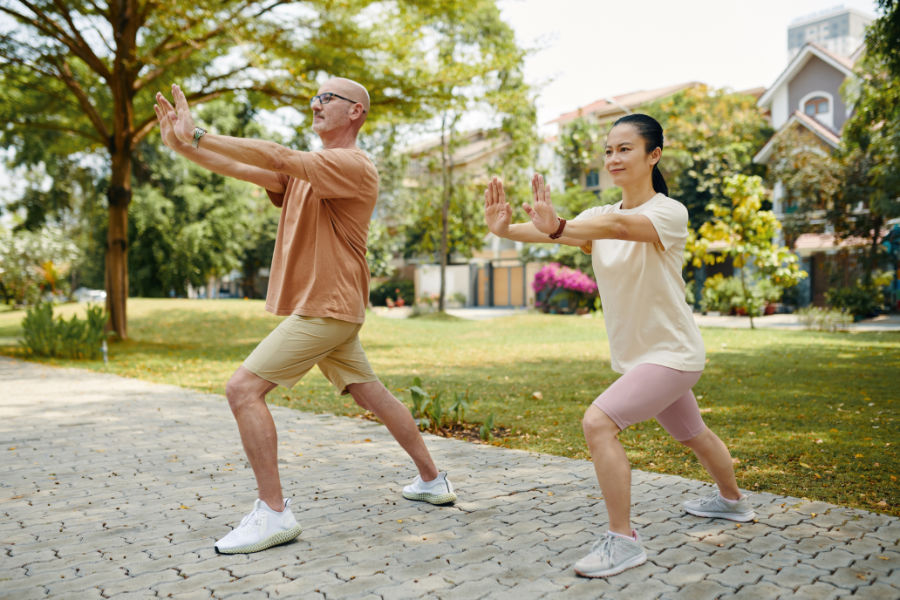
Many people are drawn to Tai Chi after hearing it described as a “moving meditation.” Yet for most beginners, this description feels confusing or even misleading. Early practice often feels mentally busy, physically awkward, and focused on remembering what comes next. Calm awareness seems far away.
This is normal.
Tai Chi does not begin as a moving meditation—it becomes one over time. As the body learns the form and the nervous system adapts, attention gradually shifts from effort to presence. What starts as learning movement evolves into sustained awareness in motion.
This article explores how that transformation happens and why it cannot be rushed.
Why Tai Chi Does Not Feel Meditative at First
In the early stages, Tai Chi demands cognitive effort. Practitioners are coordinating unfamiliar movements, managing balance, and trying not to forget the sequence. Attention is fragmented because it must be.
Meditative qualities require a degree of familiarity. Until movement becomes stable enough to require less conscious control, awareness cannot settle. This is why early Tai Chi often feels mentally active rather than calm.
The mistake many practitioners make is assuming they are “doing it wrong.” In reality, they are doing exactly what the stage requires.
Breath Synchronization Emerges Naturally
Breath in Tai Chi is not something to be forced or controlled. Over time, as movement becomes smoother and tension decreases, breath begins to synchronize naturally with motion.
Rather than consciously timing inhalations and exhalations, practitioners begin to notice:
- Breathing slows as effort decreases
- Breath responds to changes in movement
- Tension disrupts breath rhythm immediately
This organic relationship between breath and motion creates a steady internal rhythm. Breath becomes an anchor for attention, helping awareness remain embodied rather than drifting into thought.
True synchronization arises from relaxation and coordination—not instruction alone.
Continuous Awareness Replaces Fragmented Attention
As the form becomes familiar, attention is no longer consumed by mechanics. Awareness expands to include the whole body moving as a single unit.
Continuous awareness feels different from concentration. It is not narrow or effortful. Instead, it is broad and receptive. Practitioners sense balance, weight transfer, posture, and timing simultaneously without fixating on any one element.
This is a key shift in Tai Chi’s evolution. Movement no longer interrupts awareness—movement becomes awareness.
At this stage, pauses between movements disappear. The form feels continuous rather than segmented. Attention flows with the body instead of jumping ahead or falling behind.
Letting Go of the Performance Mindset
One of the greatest barriers to moving meditation is performance. When practitioners are concerned with how the form looks—either to themselves or others—awareness splits.
Over time, Tai Chi encourages a letting go of external evaluation. Movements become guided by internal sensation rather than visual appearance. This shift is subtle but profound.
Letting go of performance allows:
- Reduced self-judgment
- Increased sensitivity to internal cues
- Less tension driven by “doing it right”
When movement is no longer something to display, it becomes something to inhabit.
Signs the Performance Mindset Is Releasing
- Movements feel quieter and simpler
- Less effort is used to maintain balance
- Attention stays inside the body
- Corrections feel informative rather than critical
This internal orientation is essential for meditation in motion.
Nervous System Regulation Through Movement
One of Tai Chi’s most powerful effects is its influence on the nervous system. Slow, continuous movement combined with awareness shifts the body toward parasympathetic regulation—the state associated with calm, recovery, and clarity.
As Tai Chi matures into a moving meditation, practitioners often notice:
- Reduced reactivity to stress
- Quicker return to calm after disruption
- Improved emotional regulation
- A steady, grounded sense of presence
This regulation is not achieved through stillness alone, but through calm maintained during motion. The nervous system learns that movement does not require urgency or tension.
This is why Tai Chi’s meditative quality transfers so effectively into daily life.
Carrying Practice Into Daily Life
When Tai Chi becomes a moving meditation, its influence no longer ends when practice ends. Awareness cultivated during form practice begins to appear in ordinary activities.
Practitioners may notice:
- Improved posture while walking or standing
- Greater patience during stressful moments
- Awareness of unnecessary tension during work
- Breathing that remains steady under pressure
This carryover is a sign that Tai Chi is no longer just an exercise—it has become a way of moving through life.
How Moving Meditation Extends Beyond Practice
- Attention remains embodied during daily tasks
- Stress is noticed earlier and released sooner
- Movements become more efficient and relaxed
- Presence replaces habitual rushing
Tai Chi’s meditation is not confined to silence or stillness. It trains awareness that moves, adapts, and responds.
Moving Meditation as a Byproduct, Not a Goal
Perhaps the most important insight is that moving meditation cannot be forced. It emerges as a byproduct of consistent, attentive practice over time.
When practitioners chase calm, they often create tension. When they focus on refinement, awareness follows naturally.
Tai Chi becomes a moving meditation not because one tries to meditate, but because the conditions for presence are gradually built into the body and nervous system.
Tai Chi as Awareness in Motion
Over time, Tai Chi reveals that meditation is not defined by stillness. It is defined by continuity of awareness.
When movement no longer disrupts attention—and attention no longer interferes with movement—Tai Chi becomes what it was always pointing toward: a living meditation.
We invite you to take your Tai Chi to the next level through our membership program. Whether you want to eventually become a certified Tai Chi instructor or you just want to ensure you are in the best shape of your life using Tai Chi, our membership and community will help you with educational videos and a path to your best health. You can get started with our Tai Chi Community for free to see what the community is talking about.